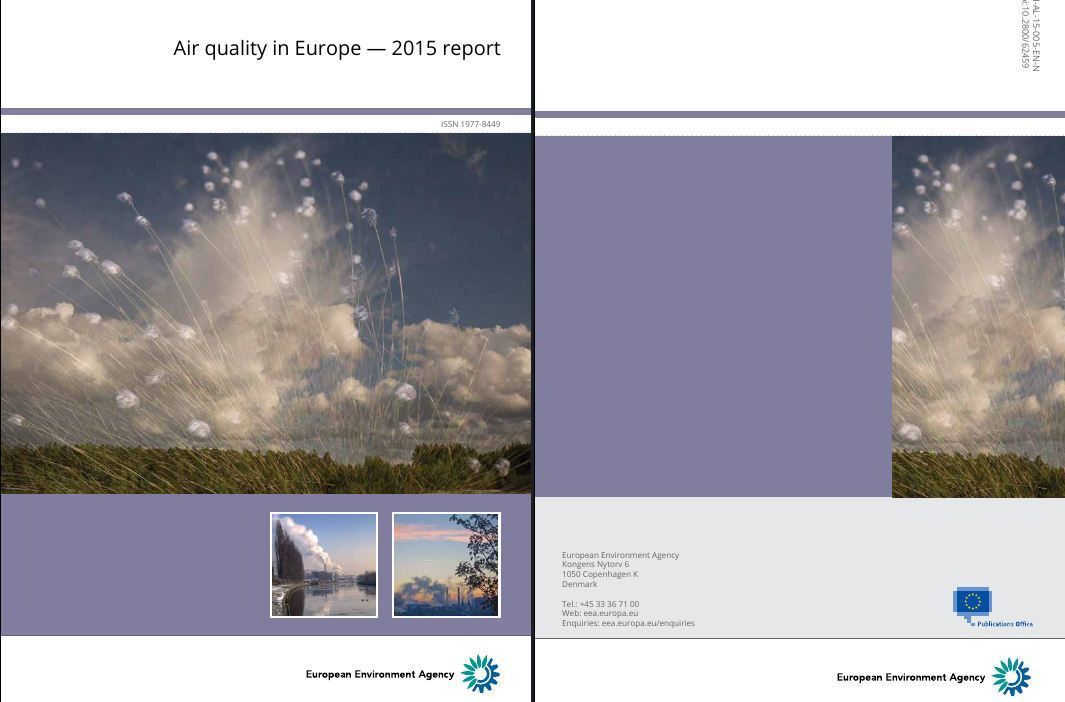
 Every year, the Air quality in Europe (AQE) Report presents an updated overview and analysis of air quality in Europe. This year the AQE report edited by the European Environment Agency (EEA) presented the progress towards meeting the requirements of the air quality directives made in 2015. Once again, the AQE report failed short to recognize the odours as a pollutant with a key impact on the air quality in Europe.
The Air quality in Europe (AQE) report analyses on an annually basis how the concentration of some chemical pollutants affects the air that we breathe in Europe. These chemicals are supposed to have the highest impact on air quality and thus on health. But where do odours stand here?
The last AQE 2015 report shows an overview of the latest findings and estimates of the effects of air pollution on health of particulate matter, ozone, nitrogen dioxide and benzo[pyrene] and other pollutants such as sulfur dioxide, carbon monoxide, toxic metals and benzene in Europe. These chemicals are supposed to have the biggest impact on air quality in the 39 European countries studied.
However, one more time, and it is now five years in a row, this report has failed to recognize odour as a key vector to study the Air Quality in a city or town in Europe. By not considering the influence of odours on the air quality in Europe, once again this report has disappointingly fallen short.
This report neglects to consider the wide scientific literature about the impact of odours on health. Reports of adverse human health effects associated with odors from industrial plants have been recorded by numerous studies1,2,3,4,5,6,7,8,9,10,11,12. The most frequently reported problems include eye, nose, and throat irritation, headache, nausea, diarrhea, cough, chest tightness, palpitations, shortness of breath, stress and drowsiness.
Many epidemiological dose effect studies have been carried out showing a strong correlation between calculated exposure to odours and surveyed percentages of odour-annoyed individuals in a population. However, it seems that the EEA has neglected this information and has presented a somewhat biased report about the air quality in Europe.
Biased cause Odours are relevant to the air quality, and they are not there.
A few references on odours and health. updated 19/07/2026
-
Aatamila, M., Verkasalo, P. K., Korhonen, M. J., Suominen, A.-L., Hirvonen, M.-R., Viluksela, M. K., & Nevalainen, A. (2011). Odour annoyance and physical symptoms among residents living near waste treatment centres. Environmental Research, 111(1), 164–170. https://doi.org/10.1016/
Andersson, L., Claeson, A.-S., Ledin, L., Wisting, F., & Nordin, S. (2013). The influence of health-risk perception and distress on reactions to low-level chemical exposure. Frontiers in Psychology, 4, Article 816. https://doi.org/10.3389/fpsyg.2013.00816
Baldwin, C. M., Bell, I. R., Guerra, S., & Quan, S. F. (2004). Association between chemical odor intolerance and sleep disturbances in community-living adults. Sleep Medicine, 5(1), 53–59. https://doi.org/10.1016/j.sleep.2003.08.005
Berkers, E., Pop, I., Cloïn, M., Eugster, A., & van Oers, H. (2021). The relative effects of self-reported noise and odour annoyance on psychological distress: Different effects across sociodemographic groups? PLOS ONE, 16(10), e0258102. https://doi.org/10.1371/journal.pone.0258102
Cantuaria, M. L., Brandt, J., Løfstrøm, P., & Blanes-Vidal, V. (2017). Public perception of rural environmental quality: Moving towards a multi-pollutant approach. Atmospheric Environment, 170, 234–244. https://doi.org/10.1016/j.atmosenv.2017.09.042
Claeson, A.-S., Lidén, E., Nordin, M., & Nordin, S. (2013). The role of perceived pollution and health risk perception in annoyance and health symptoms: A population-based study of odorous air pollution. International Archives of Occupational and Environmental Health, 86(3), 367–374. https://doi.org/10.1007/s00420-012-0770-8
Dalton, P. (1999). Cognitive influences on health symptoms from acute chemical exposure. Health Psychology, 18(6), 579–590. https://doi.org/10.1037/0278-6133.18.6.579
Dalton, P. (2003, November). Understanding the human response: How people sense, perceive and react to odors. BioCycle, 44(11), 40–43.
Dalton, P., Wysocki, C. J., Brody, M. J., & Lawley, H. J. (1997). The influence of cognitive bias on the perceived odor, irritation and health symptoms from chemical exposure. International Archives of Occupational and Environmental Health, 69(6), 407–417. https://doi.org/10.1007/s004200050168
Deane, M., Sanders, G., & Jonsson, E. (1977). Trends and community annoyance reactions to odors from pulp mills, Eureka, California 1969–1971. Environmental Research, 14(2), 232–244. https://doi.org/10.1016/0013-9351(77)90027-1
Government of Alberta. (2017). Odours and human health. Environmental Public Health Science Unit, Health Protection Branch, Public Health and Compliance Division, Alberta Health.
Heaney, C. D., Wing, S., Campbell, R. L., Caldwell, D., Hopkins, B., Richardson, D., & Yeatts, K. (2011). Relation between malodor, ambient hydrogen sulfide, and health in a community bordering a landfill. Environmental Research, 111(6), 847–852. https://doi.org/10.1016/j.envres.2011.05.021
Loos, H. M., Schreiner, L., & Karacan, B. (2020). A systematic review of physiological responses to odours with a focus on current methods used in event-related study designs. International Journal of Psychophysiology, 158, 143–157. https://doi.org/10.1016/j.ijpsycho.2020.09.010
Hooiveld, M., van Dijk, C. E., van der Sman-de Beer, F., Smit, L. A. M., Vogelaar, M., Wouters, I. M., & Yzermans, C. J. (2015). Odour annoyance in the neighbourhood of livestock farming—Perceived health and health care seeking behaviour. Annals of Agricultural and Environmental Medicine, 22(1), 55–61. https://doi.org/10.5604/12321966.1141369
Knasko, S. C., Gilbert, A. N., & Sabini, J. (1990). Emotional state, physical well-being, and performance in the presence of feigned ambient odor. Journal of Applied Social Psychology, 20(16), 1345–1357. https://doi.org/10.1111/j.1559-1816.1990.tb01476.x
Knasko, S. C. (1992). Ambient odor's effect on creativity, mood, and perceived health. Chemical Senses, 17(1), 27–35. https://doi.org/10.1093/chemse/17.1.27
Lowman, A., McDonald, M. A., Wing, S., & Muhammad, N. (2013). Land application of treated sewage sludge: Community health and environmental justice. Environmental Health Perspectives, 121(5), 537–542. https://doi.org/10.1289/ehp.1205470
Miedema, H. M. E., Walpot, J. I., Vos, H., & Steunenberg, C. F. (2000). Exposure–annoyance relationships for odour from industrial sources. Atmospheric Environment, 34(18), 2927–2936. https://doi.org/10.1016/S1352-2310(99)00514-8
Oiamo, T. H., Luginaah, I. N., & Baxter, J. (2015). Cumulative effects of noise and odour annoyances on environmental and health-related quality of life. Social Science & Medicine, 146, 191–203. https://doi.org/10.1016/j.socscimed.2015.10.043
Quist, A. J. L., & Johnston, J. E. (2024). Malodors as environmental injustice: Health symptoms in the aftermath of a hydrogen sulfide emergency in Carson, California, USA. Journal of Exposure Science & Environmental Epidemiology, 34(6), 935–940. https://doi.org/10.1038/s41370-023-00561-x
Radon, K., Peters, A., Praml, G., Ehrenstein, V., Schulze, A., Hehl, O., & Nowak, D. (2004). Livestock odours and quality of life of neighbouring residents. Annals of Agricultural and Environmental Medicine, 11(1), 59–62. (No DOI assigned.)
Ragoobar, T., Ganpat, W., & Rocke, K. (2016). Physical well-being and malodour exposure: The impact of an intensive pig farming operation on a community in Trinidad. International Journal of Science, Environment and Technology, 5(2), 635–645.
Rethage, T., et al. (2007). Körperliche Beschwerden im Zusammenhang mit Geruchsbelästigungen im Wohnumfeld: Perspektiven für eine systematische, effektive Erfassung. In VDI – Gerüche in der Umwelt. (Conference contribution; no DOI available.)
Schiffman, S. S., Miller, E. A. S., Suggs, M. S., & Graham, B. G. (1995). The effect of environmental odors emanating from commercial swine operations on the mood of nearby residents. Brain Research Bulletin, 37(4), 369–375. https://doi.org/10.1016/0361-9230(95)00015-T
Schiffman, S. S., Walker, J. M., Dalton, P., Lorig, T. S., Raymer, J. H., Shusterman, D., & Williams, C. M. (2004). Potential health effects of odor from animal operations, wastewater treatment, and recycling of byproducts. Journal of Agromedicine, 9(2), 397–403. https://doi.org/10.1300/J096v09n02_09
Shusterman, D., Lipscomb, J., Neutra, R., & Satin, K. (1991). Symptom prevalence and odor-worry interaction near hazardous waste sites. Environmental Health Perspectives, 94, 25–30. https://doi.org/10.1289/ehp.919425
Silva-Néto, R. P., Rodrigues, Â. B., Cavalcante, D. C., Ferreira, P. H., Nasi, E. P., Sousa, K. M., Peres, M. F. P., & Valença, M. M. (2017). May headache triggered by odors be regarded as a differentiating factor between migraine and other primary headaches? Cephalalgia, 37(1), 20–28. https://doi.org/10.1177/0333102416636098
Smeets, M. A. M., & Dalton, P. (2005). Evaluating the human response to chemicals: Odor, irritation and non-sensory factors. Environmental Toxicology and Pharmacology, 19(3), 581–588. https://doi.org/10.1016/j.etap.2004.12.023
Steinheider, B. (1999). Environmental odours and somatic complaints. Zentralblatt für Hygiene und Umweltmedizin, 202(2–4), 101–119.
Steinheider, B., & Winneke, G. (1993). Industrial odours as environmental stressors: Exposure–annoyance associations and their modification by coping, age and perceived health. Journal of Environmental Psychology, 13(4), 353–363. https://doi.org/10.1016/S0272-4944(05)80251-7
Sucker, K., Both, R., & Winneke, G. (2001). Adverse effects of environmental odours: Reviewing studies on annoyance responses and symptom reporting. Water Science and Technology, 44(9), 43–51. https://doi.org/10.2166/wst.2001.0505
van Harreveld, A. P., Jones, N., & Stoaling, M. (2002). Assessment of community response to odorous emissions (R&D Technical Report P4-095/TR). Env
Xu, X., Li, H., Gu, H., Zhang, Z., Li, Z., Zhang, L., Wang, J., Zhang, Y., & Wang, M. (2026). Odor-health discrepancies in urban industrial areas: Why TVOC reduction alone fails to mitigate olfactory and health risks. Environmental Science & Technology, 60(23), 16735–16746. https://doi.org/10.1021/acs.est.6c01384
If you find this article interesting, you might also be interested in these articles:
- The first draft of the BREF on Waste Treatment (WT) has been issued
- The final draft of the BREF for the Intensive Rearing of Poultry or Pigs (IRPP) has been published.
- How a European Norm about odours was born in 1991
- What do you breath in when you drive your car?
- Are we there yet? Achievements and challenges in management of environmental odours