There is no translation available.
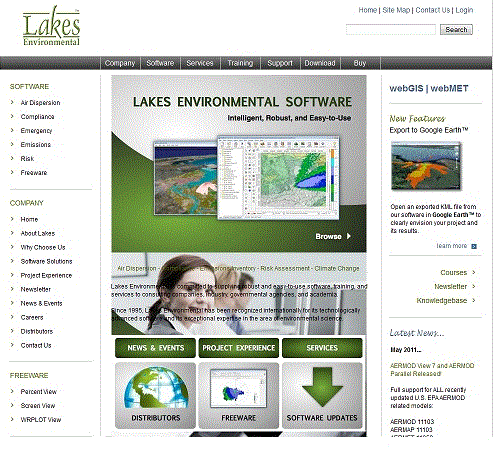
   Lakes Environmental websiteLakes Environmental is holding some courses in Toronto, Mexico City, New York, San Diego, Barcelona, Sao Paulo and Hyderabad till the end of 2011. Lakes Environmental invite you to join them for their next AERMOD courses taking place in Toronto (Canada), Mexico City (Mexico), New York (USA), San Diego (USA), Barcelona (Spain), Sao Paulo (Brazil) and Hyderabad (India) and CALPUFF courses taking place in the last three cities.

   Reserve Your Spot Today! These are the dates:

  • Toronto, Canada, from September 12 to 13, 2011.
  • Mexico City, Mexico from September 21 to 22, 2011
  • New York, USA from October 3 to 4, 2011.
  • Barcelona, Spain from October 17 to 21, 2011.
  • São Paulo, Brazil from November 7 to 11, 2011
  • San Diego, USA, from November 17 to 18, 2011
  • Hyderabad, India from December 12 to 16, 2011

   Since 1998, Lakes Environmental has been providing training for the US EPA's leading air dispersion models, AERMOD and CALPUFF. Their courses are ideally suited for those just starting their careers in the field of air quality, as well as experienced air quality professionals.

   In this Course, they provide attendees with a full understanding of the AERMOD and CALPUFF modeling systems. Their courses balance theory with hands-on real-world case studies using Lakes Environmental's advanced graphical user interfaces, AERMOD View and CALPUFF View.

   During a recent 3-day CALPUFF course, students were able to start and complete an unprecedented 9 case studies.

   Technical elements included in case studies:


  • Meteorological processing
  • Terrain processing
  • Model input options
  • Evaluation of building downwash (BPIP)
  • Evaluation of model results

   Presentation and course materials for both courses will be provided in English only. Don't miss this opportunity to be trained by their dedicated senior level experts!
 
   You want to know more about Lakes Environmental? check here!

   Are you interested in the upcoming Courses? check here!


   If you find this article interesting, you might be also interested in these articles:


There is no translation available.

This course will take place from the 19/09/2011 to 16/12/2011.

  • Area: Environment
  • Mode: On-Line
  • Subscription: € 700
  • Language: Spanish
  • Certificate: Issued by CIEMAT
  • End registration date: no end date.

This course is defined as a theoretical and practical introduction to air modelling practice. E-learning techiques are widely used to show the basic knowledge about air pollution, meteorological modelling and simulation, dispersion and chemical transformations of the pollutants. In addition, on-line practical exercises of meteorological simulation and pollutant dispersion are tutored by professors and experts in small student groups, so that at the end of the course the student will be able to face real problems related with this subject.

More information click here.

There is no translation available.

TRC training courseTRC is pleased to announce a CALPUFF training course to be held in Boulder, Colorado.  The course will be held at:

Boulder CALPUFF Training Course, March 14-16, 2011
Marriott Courtyard Hotel
 4710 Pearl East Circle
Boulder, Colorado  80301
Instructors:  Joseph S. Scire and Christelle Escoffier


CALPUFF is a Guideline Model recommended for regulatory use in the U.S. and many other international regulatory agencies.  CALPUFF is used in a wide variety of applications by registered users in over 105 countries throughout the world.  In the training course, the various applications of the model will be described, including the use of CALPUFF for the prediction of ambient pollutant concentrations, visibility impacts, and wet/dry deposition analyses.  The model's application to near-field (few tens of meters) and far-field problems (tens to hundreds of kilometers) will be presented.


This course will include a discussion of the newly released Version 6.4 of CALPUFF, which includes several major technical improvements, including:

  • New chemistry options (based on Karamchandani et al. (2008) and adapted to v6.4 CALPUFF)
  • Updated RIVAD gas phase module for SO2 to SO4 and NOx to HNO3/NO3
  • conversion
  • ISORROPIA (v2.1) inorganic gas-particle equilibrium
  • Anthropogenic secondary organic aerosol (SOA) formation based on the CalTech SOA routines implemented in CMAQ-MADRID
  • Aqueous-phase transformation adapted from the RADM cloud implementation in CMAQ/SCICHEM
  • Ammonia Limiting Method (ALM) and interface to CMAQ gridded model output for background concentrations
  • Full set of radiological pollutants for modeling of nuclear plants
  • CALPUFF nested grid options
  • Treatment of daily snow cover
  • Overwater boundary layer enhancements
  • New FLAG (2010) methodology (Method 8) for visibility in Class I areas
  • Graphical User Interface (GUI) developments
  • CALTools (variety of new applications including back trajectories, meteorological model evaluation software, wind and pollutant rose plotting)
  • CALANALYSIS (source contributions, significant contribution analysis)
  • CALPUFF Plot (Google Earth-based contour and source plots)
  • Time series plotting tool
  • New postprocessing features for 1-hour USA SO2 and NO2 standards (daily maximum 1-hr averages, 99th or 98th percentile values)


The CALPUFF Graphical User Interface (CALPRO Plus) includes options for Google Earth-compatible displays with overlaying concentration contours and 3-dimensional buildings and stacks and an interface to GIS systems using shape file output options.  For more information on  the modeling system and the courses see our web site.

The CALPUFF courses are designed for researchers, consultants, regulatory agency personnel and industrial environmental staff involved in modeling or reviewing applications of air quality models.  The courses include both technical material describing the formulation and assumptions in the model, and hands-on work solving case study problems, including a coastal application, a complex terrain case, a sub-hourly accidental release scenario, a regional haze visibility problem using the new FLAG (2010) methods and a cooling tower visible plume case study.  A discussion of the new worldwide MM5 dataset that is available for modeling will be discussed as well.

The course will cover introductory material but will also include advanced topics including a discussion of new model features including new chemistry options and the Ammonia Limiting Method (ALM).  The course does not assume prior experience with the model.  Presentation of the new technical developments, model evaluation results and new features of the Graphical User Interface (GUI) will be of interest to experienced as well as new users.

The course instructors are part of the CALMET/CALPUFF model development team. They have given more than 65 CALPUFF training courses over the past 12 years.  Registration forms, a course outline and information on hotel can be obtained from the Atmospheric Studies Group web site: (http://www.src.com/calpuff/schedule.htm).

The course fee is $1,300 USD, which includes three days of training, an electronic training manual, a set of case study problems and datasets, copy of presentation material, electronic technical papers and reference documents, and a CALPUFF DVD containing the latest versions of the CALPro Plus GUI, CALPUFF modeling system programs, processors, terrain & land use datasets covering the most of the world, and electronic versions of the User's Guides.  Access to PC computers for the hands-on portion of the course is included.  See the registration forms for details.

  Lunch each day and morning and afternoon refreshments and snacks are included in the registration fee.

Weitere Beiträge …

All the content here under Creative Commons license