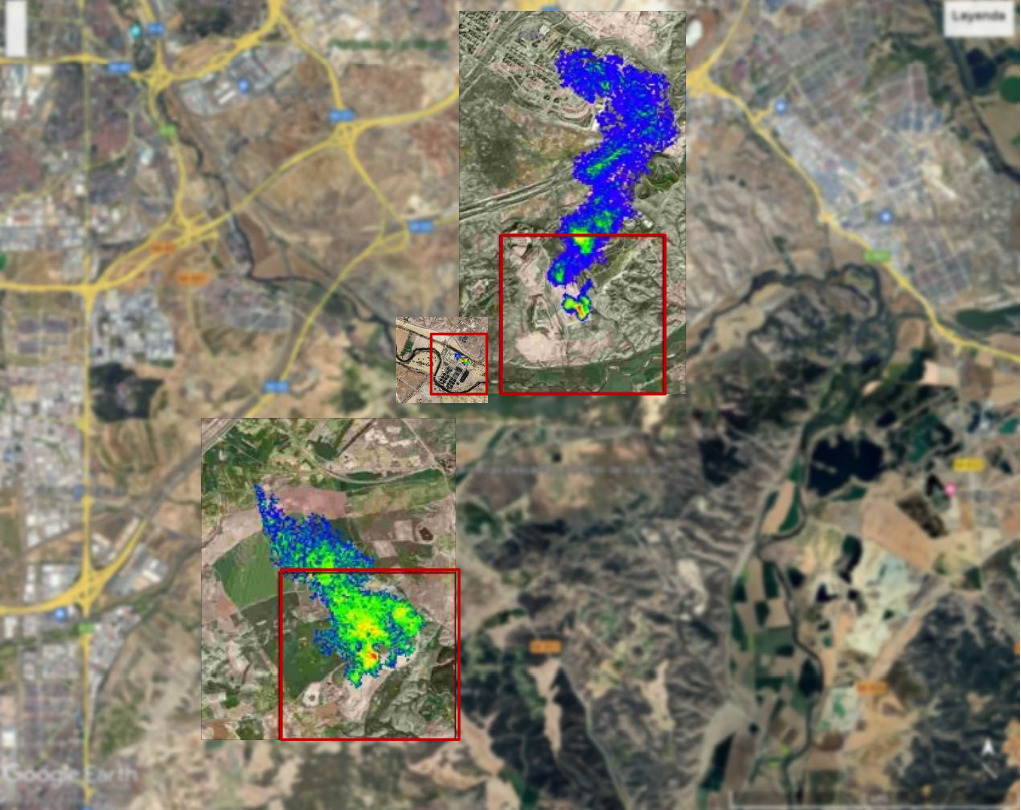
The study aims to explore the use of satellite technology (GHGSat) for measuring methane emissions and its application in quantifying odors in landfills, waste and wastewater treatment plants.
This study proposes to identify and monitor methane emission sources, a tracer gas that allows inferring the presence of odors associated with the decomposition of organic matter, through the use of satellite technology (GHGSat) with its high spatial resolution and accuracy, facilitates the identification of critical areas and the evaluation of the efficiency of odor control systems.
J. Moreno Lampaya1 & K. Kataria 2
1 Envirohub Trashform S.L.
2 GHG Sat
jmoreno@envirohub.eu
Competing interests: The author has declared that no competing interests exist.
Academic editor: Carlos N Díaz.
Content quality: This paper has not been peer reviewed.
Citation: J. Moreno Lampaya, K. Kataria, 2024, Opportunities for measuring tracer gas plumes for odor quantification with high-definition satellite, ODORA24 Conference, Barakaldo, Spain, www.olores.org.
Copyright: 2024 Olores.org. Open Content Creative Commons licence. It is allowed to download, reuse, reprint, modify, distribute, and/or copy articles in olores.org website, as long as the original authors and source are cited. No permission is required from the authors or the publishers.
ISBN: pending.
Keyword: Odor management; Methane emissions; Satellite measurement; Environmental impact; Waste treatment; Air quality; high-resolution satellite.
Abstract
The study aims to explore the use of satellite technology for measuring methane emissions and its application in quantifying odors in landfills, waste and wastewater treatment plants. Using historical data from the GHGSat satellite constellation, it proposes to identify and monitor methane emission sources, a tracer gas that allows inferring the presence of odors associated with the decomposition of organic matter. The results show that GHGSat technology, with its high spatial resolution and accuracy, facilitates the identification of critical areas and the evaluation of the efficiency of odor control systems. Additionally, the importance of this technology in developing sustainable and responsible practices for waste management and mitigating environmental impact is highlighted. The most relevant conclusions indicate that the use of methane as a tracer gas is an effective technique for identifying and monitoring odor emissions, offering a valuable opportunity to optimize waste management and improve environmental mitigation strategies.
See the full article in other languages:
- French
- Spanish
- German
- Polish
- Arabic