There is no translation available.
 CASANZ will present two significant CALPUFF events in Sydney from 18 – 21 November 2013.
· A three day Introductory CALPUFF training course: 18 – 20 November, 2013
· A one day Advanced CALPUFF training course: 21 November, 2013
All CALPUFF training courses will be conducted by members of the CALPUFF model development team, namely Joe Scire and Jenny Barclay. All participants of the courses will receive a copy of the latest version of the Graphical User Interface (GUI), CALApps, which is designed to work on 32-bit and 64-bit Windows operating systems. The new GUI has streamlined data entry procedures and improved graphics including as animated GIF files and an interface to Google Earth.
Technical enhancements to the model code include enhanced chemistry options (aqueous phase oxidation of SO2, ISORROPIA chemistry for nitrate and a secondary organic aerosol module. The use of sub-hourly meteorological data will be discussed and case studies presented. New features of the model include modelling of radioactive pollutants, a new flare module and enhancements to the overwater mixing height formulation.
OVERVIEW
1. INTRODUCTORY CALPUFF TRAINING COURSE
The three-day Introductory CALPUFF training course will be held from Monday, 18 November to Wednesday, 20 November, 2013. This session is aimed at individuals interested in air quality science who have a working knowledge of dispersion modelling. The objective of the course is to teach the proper use of CALPUFF through hands-on applications and give a thorough overview of dispersion modelling theory. This session is recommended for new users or those requiring a refresher in the operation of the modelling system, especially the new features that have been introduced in the past few years.
CALPUFF is a multi-layer, multi-species non-steady-state puff dispersion model, which can simulate the effects of time and space, varying meteorological conditions on pollutant transport, chemical transformation and plume depletion. CALMET is a diagnostic meteorological model consisting of a wind field module and micro-meteorological modules for over-water and over-land boundary layers. CALPUFF is a Guideline model recommended by the US EPA and by regulatory agencies in Australia and New Zealand and many countries throughout the world. CALPUFF is suitable for a wide variety of applications, including long-range transport, and near-field applications involving complex flows and non-steady-state situations, such as in coastal applications, calm wind dispersion, stagnation, fumigation, complex terrain and recirculation situations (e.g., land-sea breezes). The model is suitable for source-receptor distances ranging from fence-line applications (tens of metres) to several hundred kilometres.
Some of the significant features of the CALPUFF modelling system are:
· Ability to treat spatial and temporal variability in the meteorological fields including spatial variations in turbulence due to changes in land use/surface conditions
· Algorithms to treat building downwash effects from point sources, including cavity concentrations
· Detailed treatment of coastal effects, such TIBL growth and coastal fumigation.
· Ability to treat calm and low wind speed conditions
· Treatment of plume rise, including special algorithms for high temperature plumes (e.g., flares) and buoyant area source plumes (e.g., forest or agricultural burning).
· Algorithms for computation of regional haze
· Refined modules for wet and dry deposition
· Ability to treat complex terrain effects
· Chemical transformations of SO2 and NOx
The modelling system is embedded within a user-oriented interactive GUI with pull-down menus, automatic data checking, graphical displays and extensive on-line help screens. The GUI includes extensive graphics capabilities (through links to the Golden Software Surfer© package) to make animations, including animated GIF files and still images of wind vectors, concentrations, deposition patterns, wind roses and many other types of displays.
New features over the last few years will be included into the course material:
· Characterisation of the over-water boundary layer, including the use of the Coupled Ocean Atmosphere Response Experiment (COARE) flux model, enhancements in the computing mixing heights, treatment of turbulence advection and the introduction of the AERMOD turbulence profiles.
· CALMET can be run in a “No-Observations” mode or “pass-through” mode, which allows the model to be driven with output from a gridded numerical weather prediction model alone (e.g., MM5, TAPM, WRF) with no meteorological observational data. This allows CALMET and CALPUFF to be used in data sparse areas or as a fully prognostic (predictive) model for forecast applications. CALMET contains links to global geophysical datasets such as terrain elevations, land use and coastline data as well as web-based meteorological datasets.
· Treating downwash from elevated offshore platforms and special algorithms designed for high temperature plumes such as from flares or other types of fire sources. It also contains a generalised coordinate system, including options for local datums, the PRIME building downwash module, and options to treat boundary conditions and certain types of non-linear effects. The latest CALMET and CALPUFF versions can be run either with a one-hour time step or in a sub-hourly mode with meteorological data, emissions and output concentrations determined at different time steps less than one hour.
· Version 6.42 includes chemistry options (ISORROPIA nitrate/nitric acid equilibrium, aqueous phase chemistry, CalTech secondary organic aerosol chemistry) and new nested grid options.
· A new GUI has been developed called CALApps which has streamlined input of data and selection of options to the models. CALApps works with both 64-bit and 32-bit Windows operating systems. It has an advanced mode for experienced users and features to facilitate complex applications.
The model evaluation history of CALPUFF will be presented, including recent evaluation work and model inter-comparison tests. Places on this course are limited, so please confirm that you have a place before making travel or accommodation arrangements.
Discussion will also include importation of Australian datasets including meteorology, terrain and land use.
To register for this course, please complete the registration form, available on the Training page of the CASANZ website: www.casanz.org.au
If you find this article interesting, you might also be interested in these articles.
- First International Seminar of Odours in the Environment, Santiago, Chile, 4-5 March 2014
- NOSE2014. 4th International Conference on Environmental Odour Monitoring & Control 14-17 September 2014, Venice, Italy
- New update: CALPUFF course in Santiago, Chile 3rd March 2014
- ODEUR 2014 Seminar in Quebec, on March 13 and 14 2014.
- WEF Odors and Air Pollutants Conference, May 31 – June 3, 2014, Miami Florida
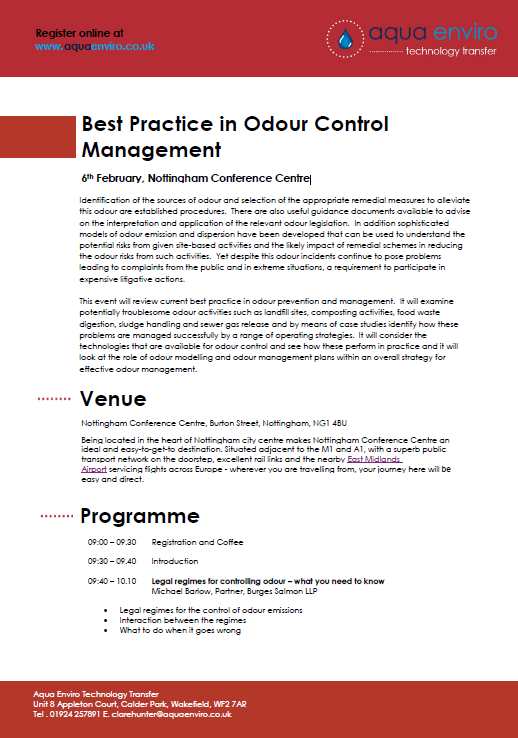 The event on Best Practice in Odour Control Management will take place the 6th February 2014 in the Nottingham Conference Centre, Nottingham, UK
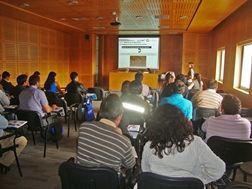 The Environmental Ministry of Chile organized a course on “introduction to odour management“ in the city of Copiapo. Around forty people asissted to this activity both from the public sectors and also representatives from the nine municipalities of the region of Atacama. The companies Odotec and Odournet have joined forces to make this happen.