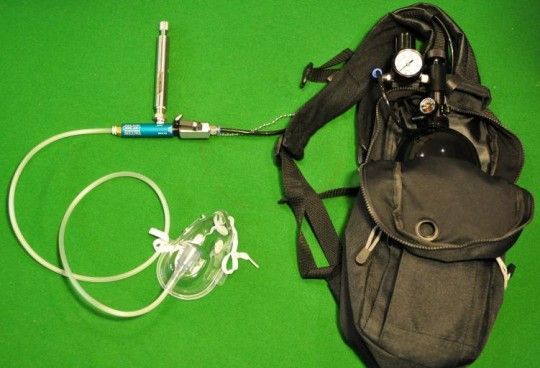
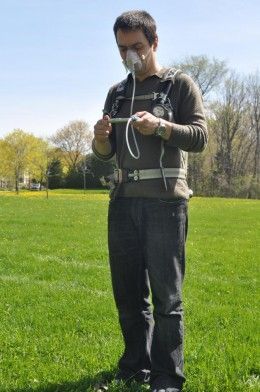
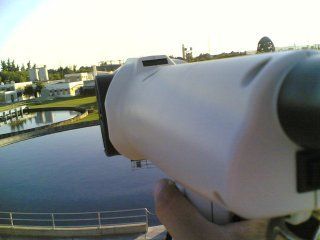
Scentroid SM100 is an in-field odour-measuring device that, according to the manufacturer, allows users to accurately quantify ambient odour strength. This device offers an easy-to-use and cost effective alternative to guessing at odour strength or using expensive odour measuring laboratories.
The SM100 draws a sample of ambient air via venture pump and dilutes it using fresh odourless air from a compressed air tank. Operator uses an adjustable sliding valve to control the ratio of fresh to ambient air.
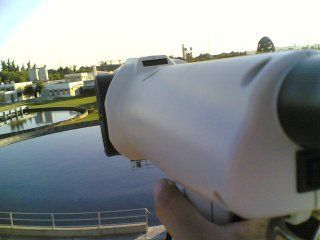
The main idea of the Field inspections is to estimate the degree of annoyance in a certain problematic area, by means of the olfactory capacities of a group of people or panel members, especially trained and "calibrated" to this effect. The main difference between field inspection and dynamic olfactometry is that in the first case, the panellist are moved to the problematic area to measure the odours on site.
There is a usual trend for technicians to try to measure odours at ambient air levels. This way of measuring odours has a few advantages:
1) Measuring odours when they produce annoyance, that is, in the receptors. 2) It is less complicated to measure at the fence line or in the receptors that in the stack.
3) In addition it could be carried on as an inspection for compliance procedures.
4) It is a similar approach to that taken for chemical compounds, that can be detected in many cases at ambient air levels.
5) You get instant values instead of averages or percentiles.
A new software suite, PlumeMapper, has been recently introduced to simplify collecting and analyzing ambient odour data. Air Environment developed this tool to streamline field surveys, replacing traditional pen-and-paper methods with mobile and desktop platforms.
PlumeMapper offers users a user-friendly solution, eliminating manual transcription errors and providing easy access to data stored in the cloud. Key features include adherence to established standards such as European EN16841, tailored forms created by Air Quality Experts, and advanced filtering options for data analysis.
Plus d'articles...
- The odour impact of broiler chickens – comparison of the theoretical approach with field panel measurements according to EN16841-2
- Comparative between PLUME VDI 3940-2 method and CALPUFF atmospheric dispersion model application
- How to set an odour management system
- 7 days left. Is your country endorsing the EN 16841?
- The Standard EN 16841:2016 on ambient odour measurement has been finally ratified
- Identification of Polluters with the Help of the Odourmap Webtool
Sous-catégories
Page 33 sur 114