There is no translation available.
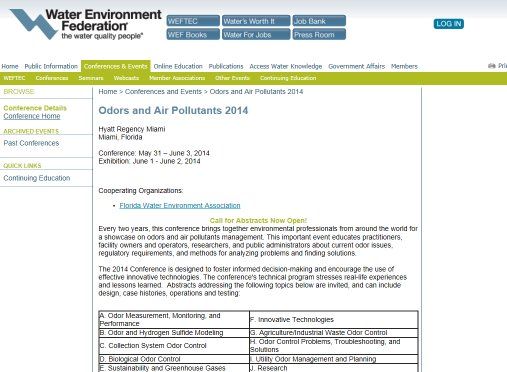
Every two years, this conference organized by the Water Environmental Federation (WEF) brings together environmental professionals from around the world for a showcase on odors and air pollutants management. This time the WEF Odors and Air Pollutants Conference will take place in Miami, Florida from the 31st of May to the 3rd of June 2014.
This important event educates practitioners, facility owners and operators, researchers, and public administrators about current odor issues, regulatory requirements, and methods for analyzing problems and finding solutions.
The 2014 Conference is designed to foster informed decision-making and encourage the use of effective innovative technologies. The conference's technical program stresses real-life experiences and lessons learned. Abstracts addressing the following topics below are invited, and can include design, case histories, operations and testing:
- Odor Measurement, Monitoring, and Performance
- Odor and Hydrogen Sulfide Modeling
- Collection System Odor Control
- Biological Odor Control
- Sustainability and Greenhouse Gases
- Innovative Technologies
- Agriculture/Industrial Waste Odor Control
- Odor Control Problems, Troubleshooting, and Solutions
- Utility Odor Management and Planning
- Research
For more information click here.
If you find this article interesting, you might also be interested in these articles.
- WEF Odors and Air Pollutants 2012 Louisville. Odors conference? Is it not H2S conference?
- Conference on Odors and Air Pollutants 15-18 April 2012 in Kentucky, USA.
- WEF/A&WMA Odors and Air Pollutants 2010, March 21 – 24, 2010 will be hold in Charlotte, North Carolina
- Monitoring the biofiltration of α-pinene vapours through municipal solid waste and pruning residues composts using an e-nose
- Managing the impact of odour emissions from livestock activities.