Press release: The Undersecretary for the Environment, Maximiliano Proaño, highlighted that this is an important milestone for coastal communities, as it seeks to improve people's quality of life by establishing stringent standards for industries.
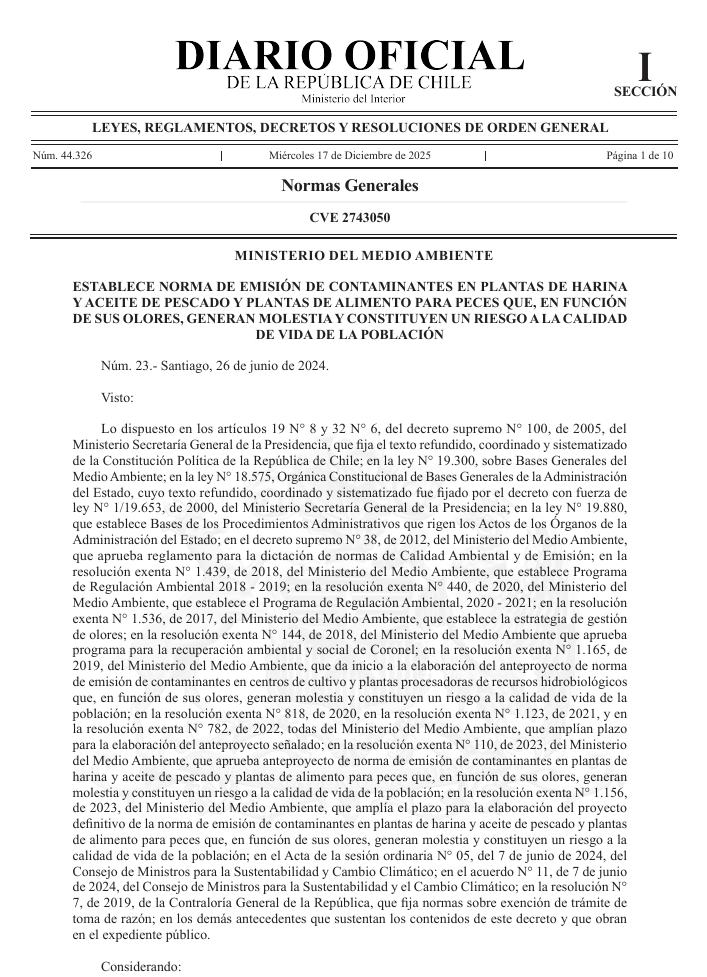
The Ministry of the Environment published in the Official Gazette the Odour Emission Standard for the Fishing Sector, a new regulation that will advance the protection of public health and the improvement of quality of life for communities living alongside industrial activities in the country's coastal zones.
The standard establishes, for the first time in Chile, odour emission limits and requirements for good operational practices for fishmeal and fish oil plants, as well as fish feed plants, covering a total of 32 facilities distributed across the national territory.
From Coronel, the Undersecretary for the Environment, Maximiliano Proaño, highlighted that “the publication of this standard is further evidence of our government's commitment to improving people's quality of life. We are addressing a long-standing demand from communities with clear, stringent, yet achievable rules”.
The new regulation sets standards based on the capabilities of available technologies in Chile, ensuring that permitted odour emission levels are measurable and controllable. Existing sources must reduce their odour emissions by 70% within four years, or demonstrate an impact equal to or less than 5 odour units, measured as the 98th percentile, while new facilities face a stricter limit of 3 odour units. The standard also incorporates requirements for good operational practices as a complement to emission limits.
The regulation will come into force on 17 June 2026, six months after its publication in the Official Gazette, and compliance will be monitored by the Superintendency for the Environment. Its development was based on technical and economic studies, field data collection, and a participation process that included a public consultation from February to May 2023, receiving 120 comments, followed by approval by the Council of Ministers for Sustainability and Climate Change in June 2024.
Implementation of this standard is estimated to significantly reduce existing odour emissions, improving the quality of life for approximately 138,000 people and helping to alleviate an environmental burden that has disproportionately affected communities and more vulnerable groups.
The regulatory process began in 2019 under the commitments of the Environmental and Social Recovery Programme (PRAS) for Coronel in the Biobío Region, and the Ministry of the Environment's Odour Management Strategy. Thus, the standard establishes a nationwide benchmark for all communes hosting these emission sources, contributing to reducing nuisance odours and enhancing community environments.
More info here.
If this news has interested you, you may also like the following articles:
- Council of Ministers approves new odour emission standard for Chile's fishing sector.
- Published on 6 February: Chile's First Law Regulating Porcine Sector Odour Emissions.
- Chile's Ministry of the Environment updates odour regulation for pulp mills.
- Chile's Ministry of the Environment celebrated Odour Day with a very special seminar.
- Chile's Ministry of the Environment is seriously committed to improving the country's odour impact.