The integral cycle of the water in the urban environment poses, in its final phase, a relevant challenge since it must solve the disposition of large amounts of sewage sludge. Since 1998, EMASESA valorizes this by-product as a valuable resource of which the farming activity can get benefit.
A. Ortiz(1) y B. López (2)
Metropolitan Company of Water Suply and Depuration of Seville, Spain (EMASESA):
1 Composting plant of Dos Hermanas. Ctra. de la Isla s/n. 41700 Dos Hermanas (Sevilla). aoarena@emasesa.com
2 Acuatic Ecology Station of Seville. Leonardo da Vinci, 10. 41092 Sevilla. blopez@emasesa.com
Keywords: Agriculture, fermentation, solar drying, environmental controls, emissions.
 Abstract:
The integral cycle of the water in the urban environment poses, in its final phase, a relevant challenge since it must solve the disposition of large amounts of sewage sludge. Since 1998, EMASESA valorizes this by-product as a valuable resource of which the farming activity can get benefit. However, sewage sludge, in the conditions in which they are produced, may generate odor problems in the installations where they are valorized.
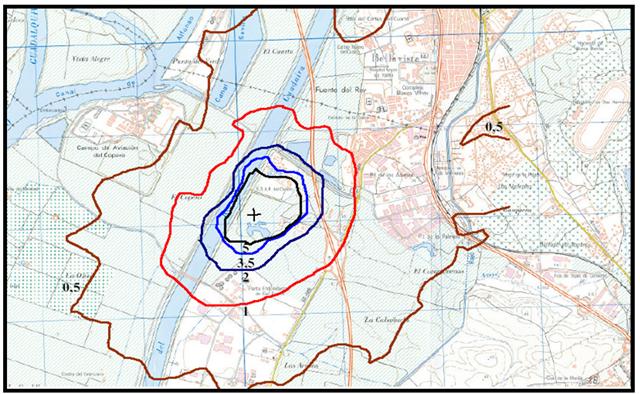
Given the presence of a population center in the nearby surroundings, olfactometric studies were initially conducted, by applying the UNE EN 13725 standard, analyzing all process stages. This information allowed acting on the phases that caused the largest impacts, with the construction of type-greenhouse closed buildings where is proceed to pre-drying of sludge with solar energy harnessing and marking exploitation guidelines focused on the same goal.
For the control and monitoring of the impact, during the largest affection period, daily measurements are performed through a field olfactometer that allows quantifying the intensity of environmental odors in immission and in real time.
In addition to the technical measures, an incidences care program has been developed in collaboration with the nearby population. This allows getting to know the possible affections, analyzing the causes and changing exploitation patterns when necessary.
Since 2004, EMASESA has been implementing actuation guidelines in order to minimize the environmental impact by the sludge composting plant odors, until reaching nowadays minimum levels of environmental affection.
- Find this article in other languages:
- Deutsch
- French
- Español
- Polski
- اللغة العربية
If you find this article interesting, you might be also interested in these articles.
- Official program of the Conference on Environmental Odour Management in Madrid, 27-28 Nov 2012
- Monitoring the biofiltration of α-pinene vapours through municipal solid waste and pruning residues composts using an e-nose
- Evaluation of capacity of a TD-GCO-MS system in air sample analysis
- 5th IWA Odour and Air Emissions Conference Jointly Held With 10th Conference on Biofiltration for Air Pollution Control. March 4 – 7, 2013, San Francisco, California, USA
- Computational Fluid Dynamic (CFD) models to tune Air Changes per Hour (ACH) in industrial buildings