There is no translation available.
 In recent years, the community has taken an active role regarding situations or factors that affect its air quality and that of its daily life, especially in those areas close to industrial sites.
Because residential areas are expanding, until they reach them, the need arises in the industry for agile and dynamic tools to assess this type of risk early. In this context, modeling of atmospheric pollutants in real time emerges as a tool with the ability to quantify the concentration levels of pollutants in the receivers based on real-time meteorological records.
A. González, R. Guerra, V. Zorich
Envirometrika, Santiago (Chile)
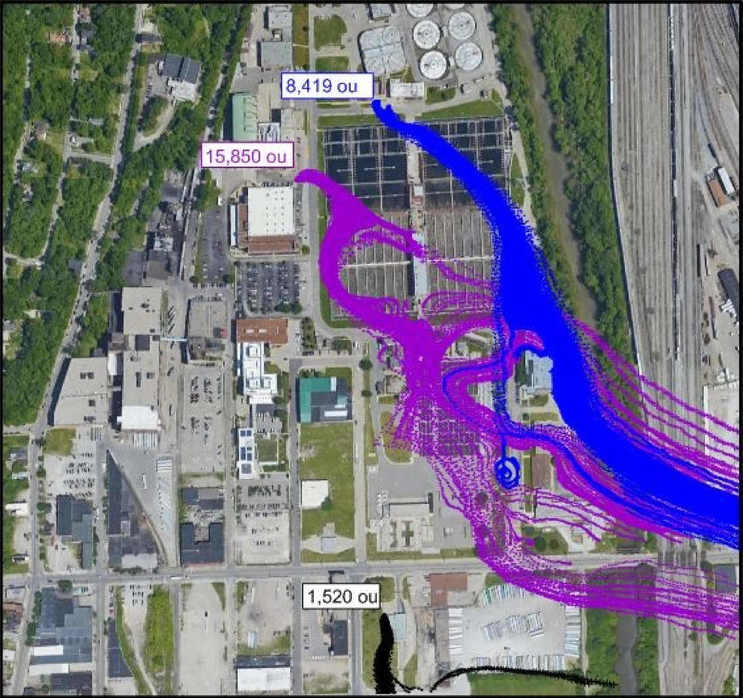 This paper presents a methodology that generates complex flow fields based on the Navier Stokes equations for fine-mode trajectory modelling. Initial u- and v-component of wind is input to the model from an onsite weather station on a 2-minute resolution.
 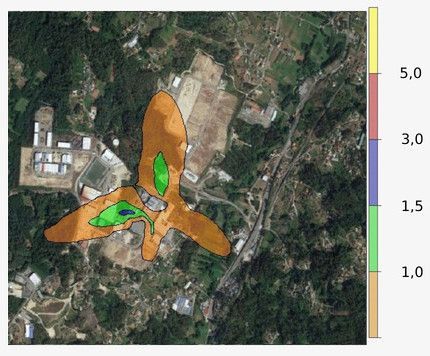 The technical recommendations in the design of stacks indicate that the emission at higher height, or a greater exhaust speed gases, decreases the impact in the surroundings. In fact, it is usual increases stack height in problematic sources.