There is no translation available.

Different alternatives exist for the removal of odours and other volatile compounds from waste gases. On one side, non-biological processes can be used (mainly absorption, adsorption, and oxidation processes)

C. Kennes, H.N. Abubackar y M.C. Veiga
 La Coruña (UDC) University, Campus da Zapateira – Ingeniería Química, Rua da Fraga 10, E – 15008 – La Coruña, España. Tel.: 34-981-167000; Fax.: 34-981-167065; Kennes_at_ udc.es

Keywords: Bioreactor, biofilter, bioscrubber, trickling filter, odours, air diffusion bioreactor.

There is no translation available.

Selection criteria for odour abatement technologies have been traditionally economic and based on the flow rate to be treated, odour concentration (or of a certain surrogate such as H2S) and removal efficiency. However, nowadays social and environmental aspects are starting to gain importance

J. M. Estrada1, B. Kraakman2,3, G. Quijano1, R. Lebrero1, R. Muñoz1
1 Valladolid University, Department of Chemical Engineering and Environment Technology
2 CH2M HILL Australia
3 Delft University of Technology, Department of Biotechnology

Keywords: adsorption, biofiltration, chemical scrubber, environmental impact, odour abatement, operating costs.
 

sesion4 estrada01Abstract

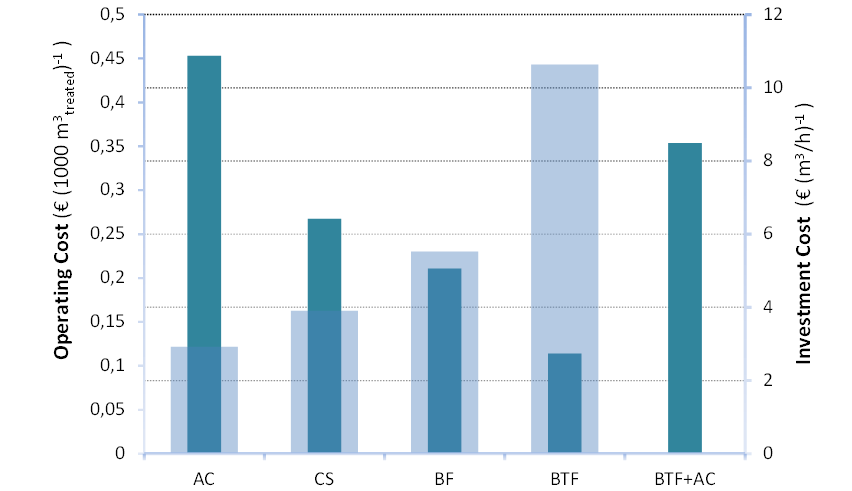
Selection criteria for odour abatement technologies have been traditionally economic and based on the flow rate to be treated, odour concentration (or of a certain surrogate such as H2S) and removal efficiency. However, nowadays social and environmental aspects are starting to gain importance.

Odour abatement systems are designed to operate over long periods of time (20-30 years) and under dynamic scenarios and conditions. Therefore, an economic analysis of sensitivity of the operating costs towards different design and operational parameters is crucial.
There is no translation available.

In Chile odour issues are becoming critical. The community is putting pressure on authorities and industry is being forced to take actions in order to minimize odour nuisances. There are approaches that allow delivering "reliable" results<

E. Contreras y V. Zorich M.

Ecometrika, Américo Vespucio 2296, Conchalí, Santiago, Chile. www.ecometrika.com, econtreras@ecometrika.cl, vzorich@ecometrika.cl.

Keywords: Belgian plume method, odour exposure impact assessment, odour control master plan.

contreras imagen engAbstract

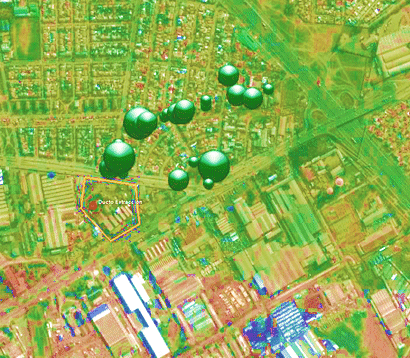
In Chile odour issues are becoming critical. The community is putting pressure on authorities and industry is being forced to take actions in order to minimize odour nuisances. There are approaches that allow delivering "reliable" results such as odour dispersion modelling, yet the question remains on how reliable the result of modelling can be. Are the results of modelling a true representation of the real odour impact and –most importantly– nuisances? In order to check the results obtained from a dispersion model, and validate how representative they are, it is essential and necessary to verify these. In this paper two case studies are presented that illustrate how methodologies by panel field can validate parallel modelling approaches. In both case, validation process was a valuable tool for detecting errors and obtaining reliable results. We conclude that modelling results must be validated by another methodology or they can be clearly misleading.


  • Find this article in other languages:
  1. Deutsch
  2. French
  3. Español
  4. Polski
  5. اللغة العربية


If you find this article interesting, you might be also interested in these articles.


Altri articoli …

All the content here under Creative Commons license