 As the olores.org site was started, well over 6 years ago, to be honest, I did not believe that it was going to last this long. At that time there was no ready information available on the net about the different approaches to deal with odour emissions, just a few dispersed papers and some information spread by a small group of scientists and consultancy companies.
Olores.org was initiated just as a quick information tool for the Spanish speaking countries and it did not pretend to go further than this, with just a small static site made with materials and ideas collected during a short stay at egmasa. However, with the help and economic support of a couple of companies, olores.org became this multilingual, dynamic, open access platform with over 242.000 page loads since its very beginning from over 127 countries and with an increasing amount of collaborations from international authors.
The companies that believed at that time in the project of olores.org where the German company Ecoma (nowadays part of the Odournet group) and the Spanish firm Labaqua.
A few years ago, a visit was paid to Ecoma in their installations in Honigsee, Germany but the chance to visit the facilities of Labaqua did not arise until recently.
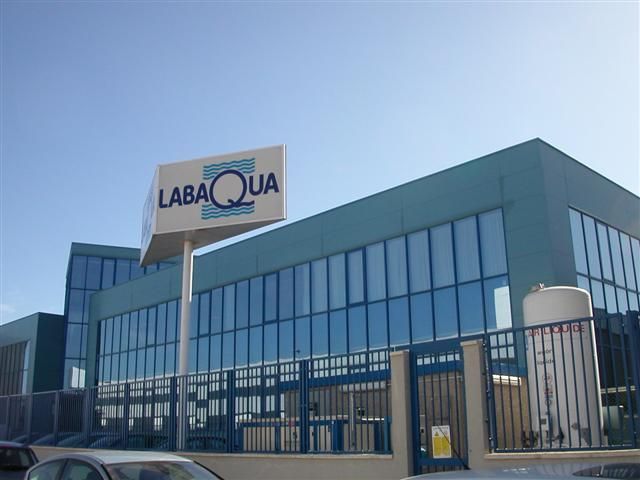
Today, I would like to talk today about the company Labaqua, a Spanish firm based in Alicante that has been dealing with environmental odour management since its very beginning, till the point that nowadays I would say it is a reference organization in Spain in these matters. For example, Labaqua was the first company in Spain that got accredited to determine odour concentration by means of dynamic olfactometry following the EN 13725 Standard, leading the way to other Spanish companies (1). This was possible thanks to the interest and work of many people, but I would like to mention at this point to two of them: Ignacio Valor, from the Labaqua side and Manel Almarcha as collaborator from the Spanish National Accreditation Body (ENAC) side.
Thanks to their perseverance and stubbornness, Spain got it first accredited lab, Labaqua following the path of other Dutch, German, French and UK companies.
The first time I met Ignacio Valor Herencia was at a Conference organized by the German Association of Engineers (VDI) in Cologne, Germany in 2004. We did not have the opportunity to talk too much at that time, I was just a newbie, with just a year of work with odours. it could be stated that at that time Ignacio was one of the main actors in setting up and spreading the word in Spain. After all it was also a question of business…
Nowadays Ignacio has abandoned the olfactometric issues to focus in other areas in Labaqua but he is still connected with the people of the Olfactometric Department in many aspects.
It was in November 2009 when a visit to Labaqua was finally paid, just before a trip to an odour conference in Baden-Baden.
In any case, I already knew a bunch of people working there:
The first time I met José Vicente Martínez was at a meeting with the regional administration. At that time a sugar factory was a main actor in odour complaints in that area and an olfactometric study was requested. We could not speak too much in that moment and we did not have the opportunity to meet again to talk about this sugar factory as the odour problem was rapidly solved with the help of the radical cuts taken by the Common Market Organization for sugar agreed by the EU agricultural ministers in 2007.
The factory had to be closed.
Later, I had the chance to hear Jose Vicente's speech at a conference about odours in Seville. We talked a few minutes about his presentation and about the idea that sometimes sampling odours was not just that easy if we wanted to be sure about the representativeness of a sample. José Vicente Martínez is nowadays the manager of the olfactometric laboratory in Labaqua.
Many other interesting people of Labaqua participated at that conference. Juan Manuel Suarez performed a very interesting demonstration about sampling air at immision level with his Cryocore. At that time, around 120 attendants at the Seville conference were impressed with the capacity of this device. Later we could see again this demonstration in Madrid and later in Barcelona.
In Baden-Baden, we met again for the VDI conference “odours in the environment” and a suggestion was made to him to publish some paper in olores.org about the Cryocore device with numbers and facts, while we enjoyed a warm sausage and a local beer in the Christmas market just after the conference (2) in Baden-Baden.
Beforehand, I had the opportunity to see the Cryocore in action during my visit in Labaqua. I don't know if they finally got the patent for this device, but I am sure that once they get it, this technique is going to be a main actor in the coming years regarding air quality sampling.
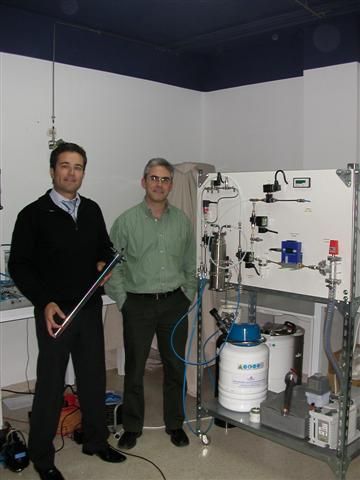 |
Ignacio Valor and Juan Manuel Suarez standing by the Cryocore prototipe |
Ignacio Valor and Monica Pérez, helped as tour operators through the many activities that Labaqua does. Olfactometry is just a small portion of Labaqua's cake. Just have a look to the website of this company to see the many activities that Labaqua does. Among the recent projects, was the development a new service for atmospheric dispersion modeling with the acquisition of a server adapted to the very specific requirement of a calpuff/MM5 modeling.
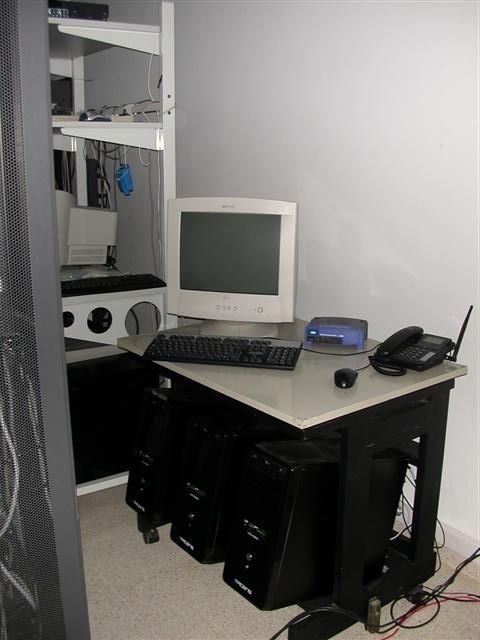 |
Servers for Calpuff/MM5 modelling |
They are also researching in the very obscure world of the emission from fugitive sources with a new an innovative approach using Computational Fluid Dynamics CFD to, for example, calculate odour emission rates from natural ventilated buildings.
I know you were waiting for this, so here there is a picture of the olfactometric team in Labaqua. They are all sound professionals and I would like to congratulate to all of them for their work.
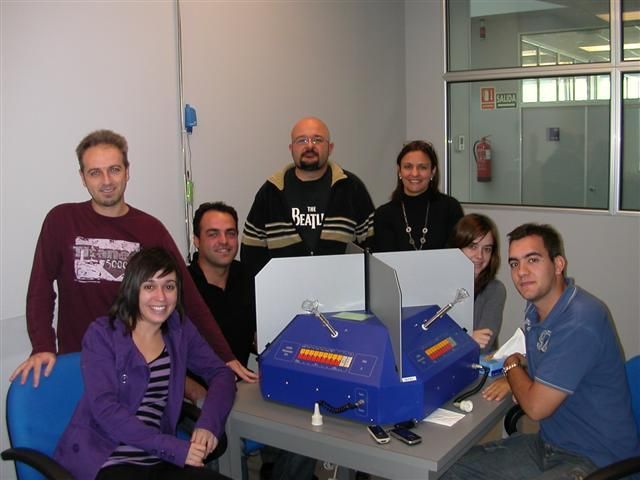 |
LABAQUA's team in their olfactometric lab |
Together with other laboratories en Spain, they are showing to the companies, public administration and people in general that IT IS POSSIBLE TO MANAGE ODOURS IN THE ENVIRONMENT. We have tools for that.
I would like to thank also to two people not mentioned here: Vicente Javier, who has been very kind and helpful along these years of professional contact and Tony, who I met in the last NOSE conference in Florence and in Madrid for the CONAMA10 odour group.
Tony is both a professional with many years of experience in Labaqua and an Hercules football team supporter who, as I was once told, is able to cook the best paellas of Alicante.
Never tried one, though...