There is no translation available.

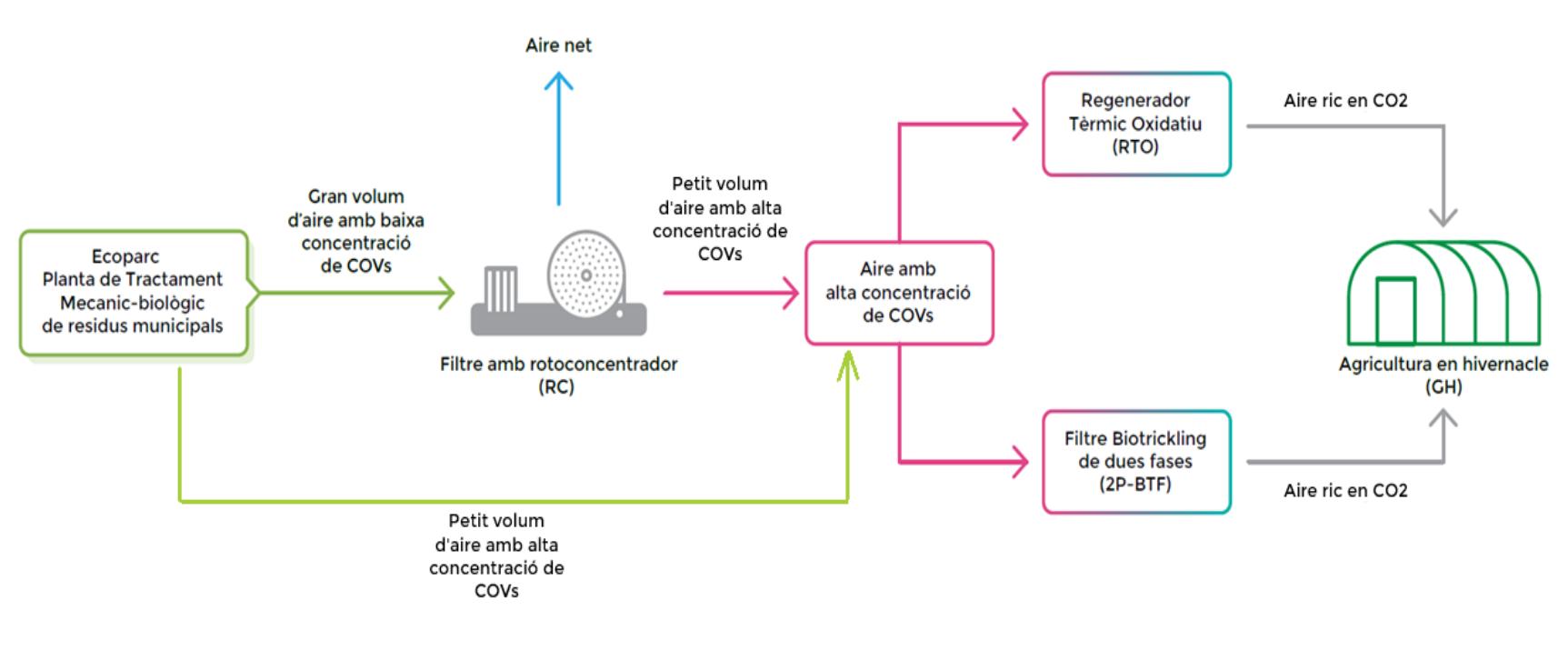
   The European project LIFE ABATE (LIFE22-ENV-ES-LIFE-ABATE/101113838) aims to significantly reduce volatile organic compound (VOC) emissions, odor impact, energy requirements (natural gas and electricity savings), and operating costs of mechanical-biological treatment (MBT) waste plants.

   The LIFE ABATE project proposes two solutions using zeolite rotary concentrators: one with thermal oxidation and another with biological treatment in biotrickling filters. CO₂ generated will be reused in greenhouses, and zeolite selection requires air characterization via TD-GC-MS.

G. Sánchez a*, J. C. Fernández a, J. Hereza a, E. Regidor b,c, R. Muñoz b,c, A. González d, M. Gil d, O. Prado e, R. Montes e, M. Macarulla f, S. Gasso f y R. Lebrero b,c

a Àrea Metropolitana de Barcelona, Barcelona, Spain
b Institute of Sustainable Processes, University of Valladolid, Spain
c Department of Chemical Engineering and Environmental Technology, University of Valladolid, Spain
d Kalfrisa Energía y Medio Ambiente, Zaragoza, Spain
e Aeris Tecnologías Ambientales S.L., Barcelona, Spain
f Research Institute for Sustainability Science and Technology, Technical University of Catalonia, Spain
g FCC Medio Ambiente, Madrid, Spain
*ssantos@amb.cat . Dirección postal: C. 62 núm. 16-18, Barcelona 08040. Phone number: +34 935069545
There is no translation available.

   The Spanish Association of Water Supply and Sanitation (AEAS) agreed in 2018 to create a specific sub-group dedicated to odour management (SGO) within the Operations, Technology and Energy group of AEAS. Five years later, AEAS has elevated the status of the SGO to become a fully-fledged group. This is fantastic news for any odour manager interested in this sector.

   On Wednesday 11th May, the plenary meeting of the Commission V of the Spanish Association of Water Supply and Sanitation (AEAS) took place. At this meeting, it was decided that the Odour Management Subgroup would become the Odour Management Group (GGO), no longer under the umbrella of the Operations, Technology and Energy Group. This decision adds more weight and responsibility to the group of people working on various odour management projects.

There is no translation available.

   The revised ASTM D6826-23 Standard Specification for Sprayed Slurries, Foams, and Indigenous Materials Used As Alternative Daily Cover for Municipal Solid Waste Landfills was published last week. Daily covers are an essential issue in managing odor release in landfills. This specification has been around for around 15 years, and this is the fifth revision of the text. 

   This specification defines procedures for determining the performance of certain landfill daily cover materials such as sprayed slurries, foams, and other materials generally described as an alternative daily cover (ADC) for municipal solid waste landfills. This standard specification does not apply to other types of landfills. Also, the text does not apply to geosynthetics used as ADC such as this one.

Więcej artykułów…

All the content here under Creative Commons license