There is no translation available.
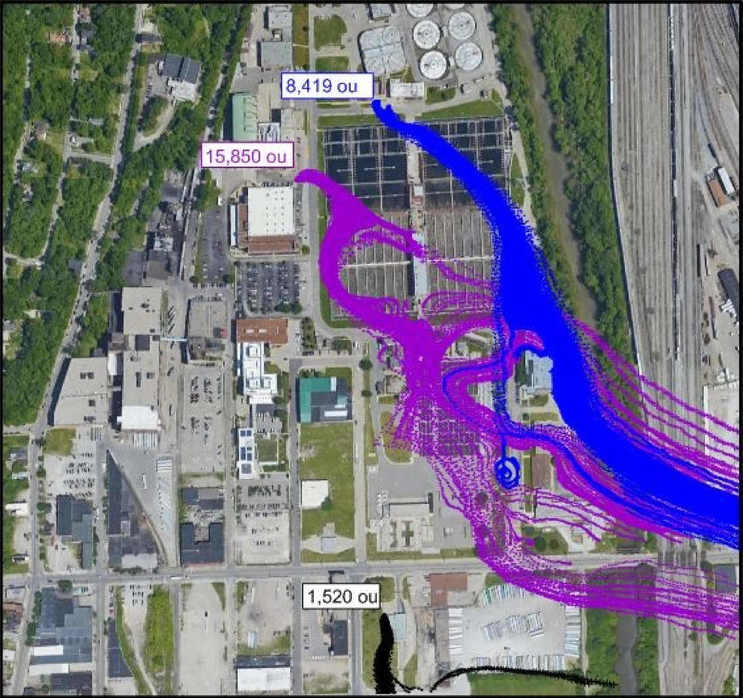
P11Ip   This paper presents a methodology that generates complex flow fields based on the Navier Stokes equations for fine-mode trajectory modelling. Initial u- and v-component of wind is input to the model from an onsite weather station on a 2-minute resolution.

   The perturbated flow is then calculated in an iterative fashion until the numerical solution converges. The results are then be stored and the next initial u- and v-component of wind will be input from the anemometer. Each solution is stored and converted for use in a particle trajectory model.

P. D’Abreton1, R. Ormerod1, L. Marchant2

1 Envirosuite, Brisbane, Australia
2 Envirosuite, Santiago, Chile
Für den 22. Mai 2025 wurde ein Online-Workshop über die CALPUFF/CALMET-Luftqualitätsmodellierung mittels TEAMS vorgeschlagen. Diese Veranstaltung wird von Herrn David Lyder, Senior Air Modelling Standards Engineer der Air Policy Section der Regierung von Alberta, zusammen mit Herrn Madhan Selvaraj, Herrn Wally Qiu und Herrn Piotr Staniaszek organisiert . Ziel ist es, Rückmeldungen aus der Gemeinschaft der Luftqualitätsmodellierer einzuholen. Ziel der Veranstaltung ist es, zu erfahren, welche Aktualisierungen die Fachleute in das CALPUFF/CALMET-System aufnehmen möchten.

Das Luftqualitätsmodellierungssystem CALPUFF/CALMET ist ein wesentliches Instrument für die Modellierung von Luftqualitätsvorschriften und wird weltweit eingesetzt. Es wurde jedoch seit einiger Zeit nicht mehr aktualisiert und muss verbessert werden, um die beste verfügbare Wissenschaft und Methodik zu berücksichtigen. Auf der Konferenz 2024 der Air & Waste Management Association in Calgary, Alberta, wurde festgestellt, dass der kürzliche Erwerb des CALPUFF/CALMET-Codes durch Lakes Environmental Inc. eine ideale Gelegenheit bietet, diesen Aktualisierungsprozess zu beginnen.


There is no translation available.

   The second draft of the international handbook on dispersion modelling is now available and open for comments. There are now 45 days to submit comments. Your comments are welcome if you are an expert in odour management or dispersion modelling. The due date to submit comments is 9 July 2023. The final version of the handbook is expected to be ready by September 2023.

   More than 50 experts worldwide signed up for this initiative in 2020. Currently, around 20 volunteers are actively involved in developing this document. Monthly meetings were held online on the last Thursday of each month at alternative times separated by 12 hours to have a more equitable distribution of time slots for volunteers from different time zones.

Weitere Beiträge …

All the content here under Creative Commons license