There is no translation available.
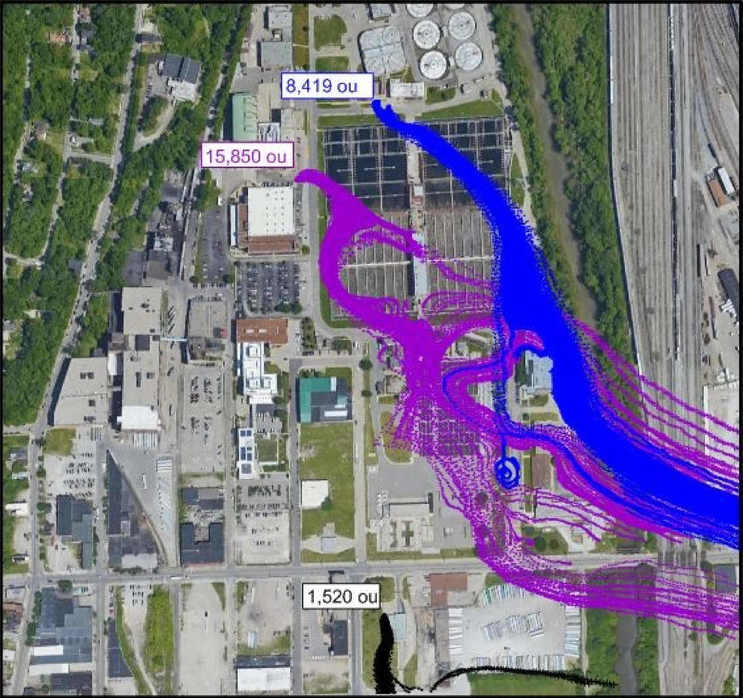
P11Ip   This paper presents a methodology that generates complex flow fields based on the Navier Stokes equations for fine-mode trajectory modelling. Initial u- and v-component of wind is input to the model from an onsite weather station on a 2-minute resolution.

   The perturbated flow is then calculated in an iterative fashion until the numerical solution converges. The results are then be stored and the next initial u- and v-component of wind will be input from the anemometer. Each solution is stored and converted for use in a particle trajectory model.

P. D’Abreton1, R. Ormerod1, L. Marchant2

1 Envirosuite, Brisbane, Australia
2 Envirosuite, Santiago, Chile
Warsztaty online na temat modelowania jakości powietrza CALPUFF/CALMET za pośrednictwem TEAMS zostały zaproponowane na 22 maja 2025 roku. Wydarzenie to jest organizowane przez pana Davida Lydera, starszego inżyniera ds. standardów modelowania powietrza w sekcji polityki powietrznej rządu Alberty, wraz z panem Madhanem Selvarajem, panem Wally Qiu i panem Piotrem Staniaszkiem. Pomysł polega na zebraniu opinii od społeczności zajmującej się modelowaniem jakości powietrza. Wydarzenie będzie miało na celu wysłuchanie, jakie aktualizacje specjaliści chcą włączyć do systemu CALPUFF/CALMET.

System modelowania jakości powietrza CALPUFF/CALMET jest niezbędnym narzędziem do modelowania jakości powietrza i jest szeroko stosowany na całym świecie. Jednak od pewnego czasu nie był aktualizowany i wymaga ulepszeń w celu uwzględnienia najlepszych dostępnych nauk i metodologii. Podczas konferencji 2024 Air & Waste Management Association, która odbyła się w Calgary w Albercie, uznano, że niedawne nabycie kodu CALPUFF/CALMET przez Lakes Environmental Inc. stanowi idealną okazję do rozpoczęcia procesu aktualizacji.


There is no translation available.

   The second draft of the international handbook on dispersion modelling is now available and open for comments. There are now 45 days to submit comments. Your comments are welcome if you are an expert in odour management or dispersion modelling. The due date to submit comments is 9 July 2023. The final version of the handbook is expected to be ready by September 2023.

   More than 50 experts worldwide signed up for this initiative in 2020. Currently, around 20 volunteers are actively involved in developing this document. Monthly meetings were held online on the last Thursday of each month at alternative times separated by 12 hours to have a more equitable distribution of time slots for volunteers from different time zones.

Więcej artykułów…

All the content here under Creative Commons license