There is no translation available.
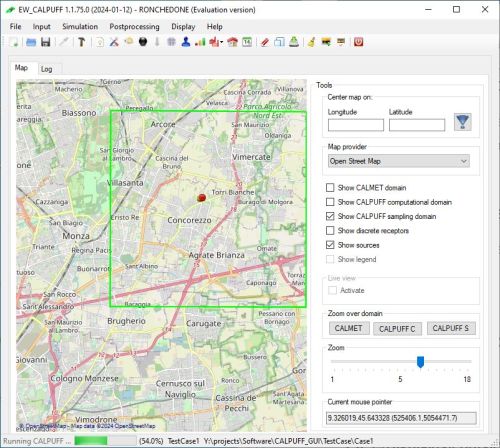
Enviroware, an Italian company specialised in air quality consulting, has released version 7.2.1 of its EW_CALPUFF, a graphical user interface (GUI) dedicated to easily manage the Lagrangian puff model CALPUFF, widely used in atmospheric dispersion modelling for pollutants and odours.
If you work with odour modelling, you are probably familiar with the dispersion model CALPUFF. This is a propietary, source-available (not open-source) non-steady-state Lagrangian puff model used to simulate pollutant transport, transformation, and deposition, taking into account time- and space-varying meteorological conditions. The official proprietary software (not open-source) CALPUFF core models (CALMET, CALPUFF, and CALPOST) are free to download and can be run via the command line, although the GUI requires a paid licence. In the past, there were several other GUIs available, such as CALPro, CALApps, Beeline, or MMS-CALPUFF but most of these have now been discontinued. Another well-known GUI is this one of the Italian company Enviroware that has been recently updated. This release introduces two new features.
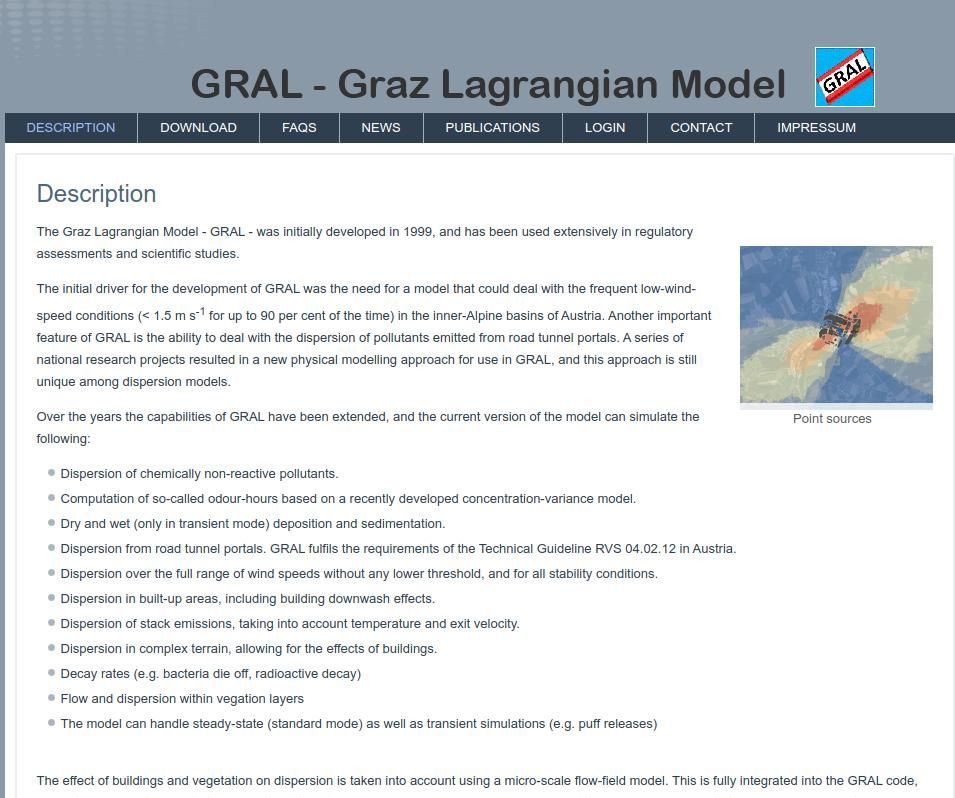 The Graz Lagrangian (GRAL) system is a Lagrangian particle model with a free Graphic User Interface (GUI) available in both Linux and Windows. Now the developers have released the
  Some guidelines are necessary to help environmental managers of industrial plants and environmental technicians of Environmental Regulatory offices in order to avoid mistakes when choosing dispersion modelling software.