There is no translation available.
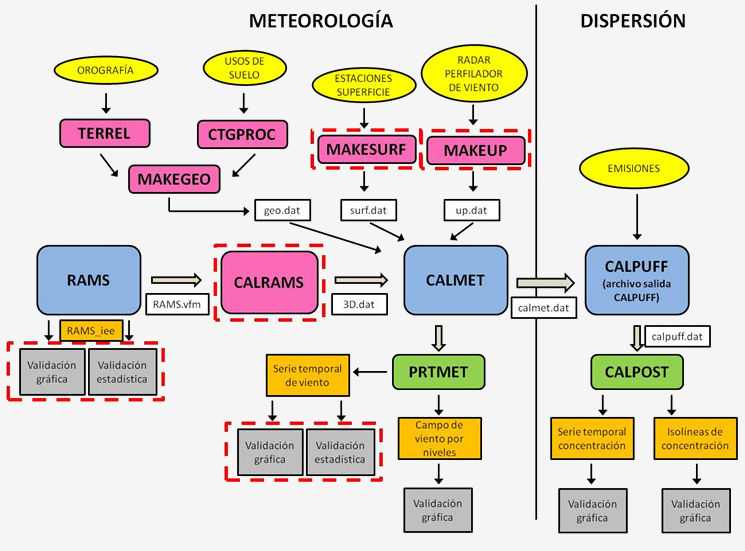 The current problems in relation to odor pollution episodes make it necessary to have methods to assess odor impacts. Such assessment can be performed using dispersion models that allow to estimate odor concentrations considering the emissions, the meteorology and the topography, among other data.
Pollutant dispersion modeling is usually based on minimum averaging times of one hour; however, some pollutants require shorter averaging times, as it is the case of odors. Recently, the Atmospheric Research Group of the Faculty of Engineering of Bilbao has set up a methodology to perform dispersion studies using sub-hourly temporal resolution.
P. Uriarte*, V. Valdenebro, E. Sáez de Cámara, G. Gangoiti and M. Navazo.
Universidad del País Vasco / Euskal Herriko Unibertsitatea (UPV/EHU), Escuela Técnica Superior de Ingeniería de Bilbao, Alameda Urquijo s/n, 48013 Bilbao.
*puriarte002@ikasle.ehu.eus
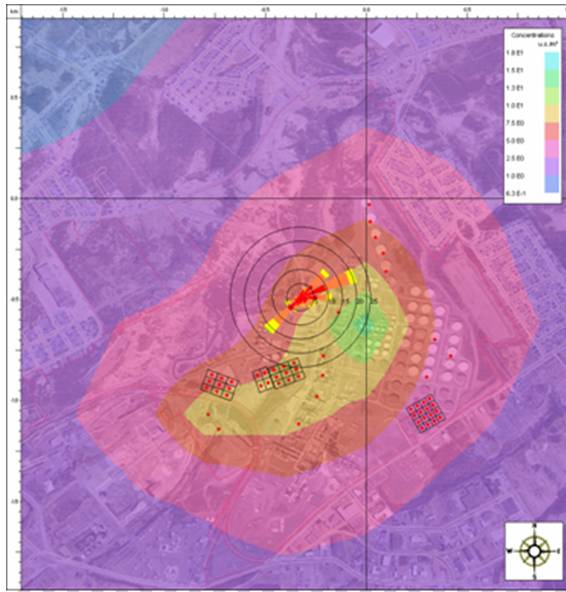 Dispersion modeling defines the relationship between the emission source and the receptor. While control measures may be applied to the emission source, compliance with odor nuisance standards depend on whether the odor concentrations at the receptor have been adequately reduced with respect to their frequency, intensity, duration and location.
 The 27th of August 2020 took place the kickoff meeting of the group dealing with the development of the first international guideline on the assessment of odour exposure by using dispersion modelling. To date, there are already 36 professionals from Belgium, Italy, France, Chile, Ecuador, Australia, Brazil, United Kingdom, Ireland, China, Spain, USA, India, Peru, Qatar and Austria participating in this initiative.