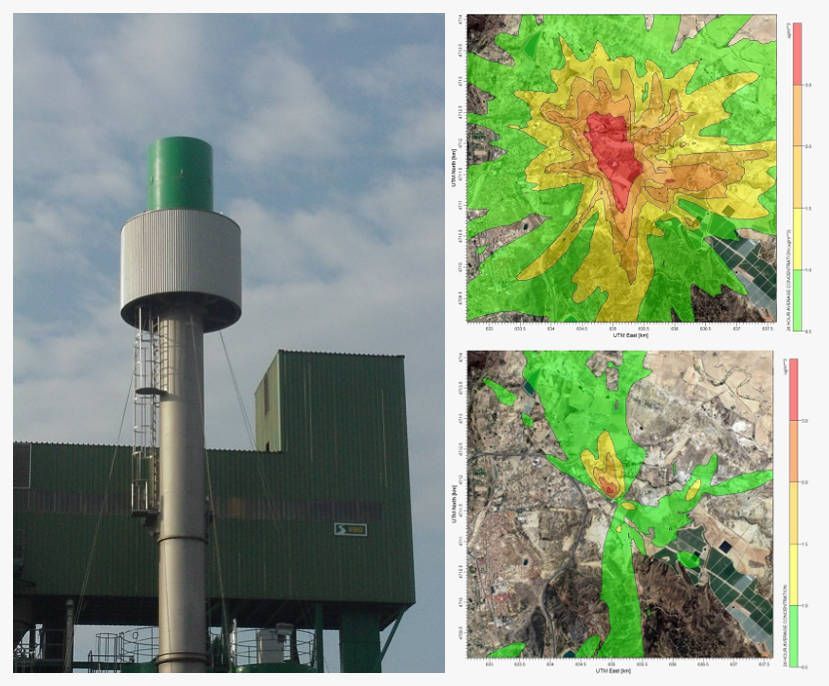
 For the industrial sector, in many occasions it is the directed sources that are the main route of emission of pollutants into the atmosphere. In these cases, the technical recommendations for minimizing the impact of industrial emissions on the environment indicate the chanelling of these emissions for dispersion at some height as a first step towards establishing possible corrective measures.
The emission of these pollutants at a higher altitude, or with a higher gas exit velocity at the focus, minimizes the impact on the environment. Using this principle as a basis, additional propulsion systems have been designed for directed sources. This propulsion is achieved by installing a turbine on the upper exterior of the chimney. In this study, the Calpuff atmospheric dispersion model was used for the evaluation of the improvement in the environmental quality obtained in the surroundings of a chemical industry installation, from the installation of three Eolage (Delamet) propulsion systems, on three chimneys.
Antonio Amo Peña *, Juan Manuel Juárez Galán, Rubén Cerdá Ortiz
* Labaqua S.A. Pol. Industrial Atalayas 16, 03110 Alicante, antonio.amo@labaqua.com
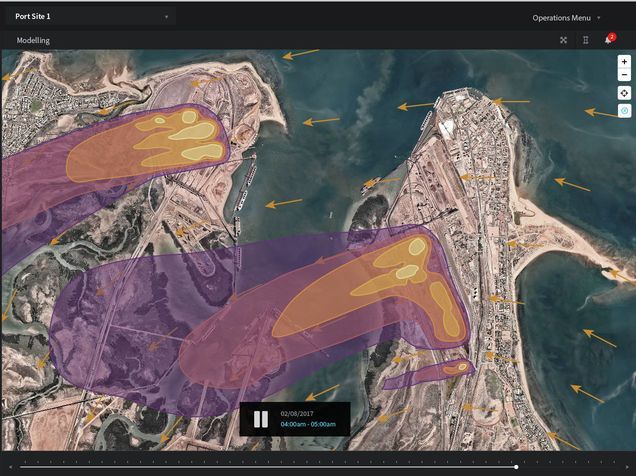 Currently, odour modelling maps represent a static photo on the impact assessment in P98, 1h. This information allows the proper design of odour control measures, regarding emission reduction or better dispersion. However, this information is not enough to carry out an operational and proactive odour management, which is associated with the operations at installations.
 The USEPA approved in July 2016 an update of CALMET and CALPUFF from V5.8.4 to V5.8.5. This update includes code changes described in Model Change Bulletin H and include fixes to bugs in the implementation of PRIME downwash, along with updates to eliminate specific compilation and list file errors. Three years later after the