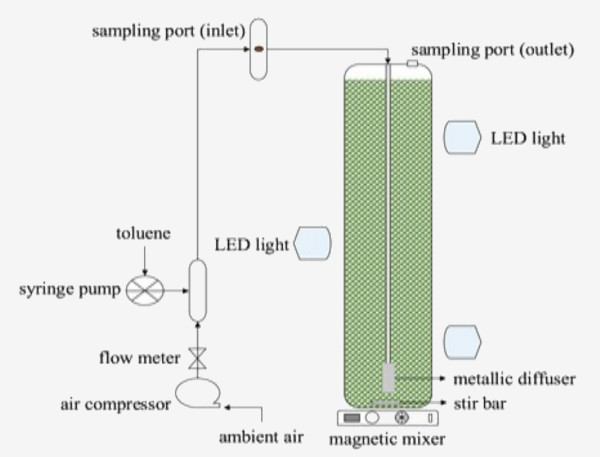
37 001   Volatile Organic Compounds (VOCs), commonly found in the atmosphere, are odorous compounds with negative effects on human and environment. VOCs and odours emitted from industrial sources have been demonstrated as hazardous and annoying compounds which may cause negative effects on humans and environment.

   The control of these compounds is therefore a key action by the plant managers in order to avoid complaints and negative impacts. In this study, microalgae and bacteria were implemented in a vertical tubular photobioreactor for the biodegradation of toluene, used as model VOC. Chlorella vulgaris strain was chosen as photosynthetic platform due to their high adaptability to adverse environmental conditions.
42 003

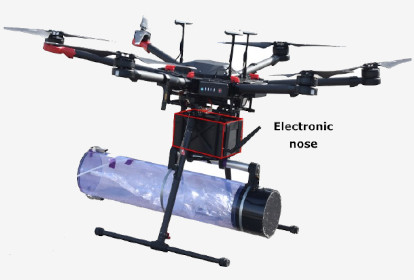
   Wastewater treatment plants (WWTPs) produce gaseous emissions that might be olfactory annoying to the surrounding population. Current odour assessment methodologies are based on costly and infrequent olfactometry measurements involving human panels, and continuous monitoring of few gases via fixed gas detectors installed on the plant.

   This leads to odour measurements with low temporal and spatial resolution, hindering an accurate characterization of the odour episodes. The main goal of the SNIFFDRONE project, presented in this paper, is to develop a drone with olfaction capabilities to acquire spatially-dense odour measurements and localize the source of odour nuisances in WWTPs.

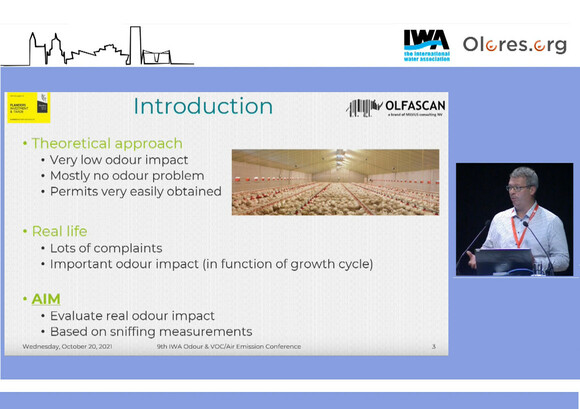
42 003    In the Flemish legislation, no odour assessment framework is implemented, despite that odour-related permit applications require the inclusion of an odour impact study. For livestock farming, odour emission factors, derived from olfactometric measurements (ouE), are widely used. Contrastingly, the available assessment tools, based on earlier odour impact research, utilize sniffing measurements (se).

   To allow comparison between the two units of odour, it is assumed that 1 ouE equals 1 se. For most groups of livestock animals with a rather constant growth cycle (e.g. pigs), this comparison is deemed valid and suitable for evaluating the odour impact. However, the theoretical assessment of broiler chicken emissions can be questioned, as the olfactometric emission factor of 0.33 ouE/s.animal results in almost no odour impact.


More Articles …

All the content here under Creative Commons license