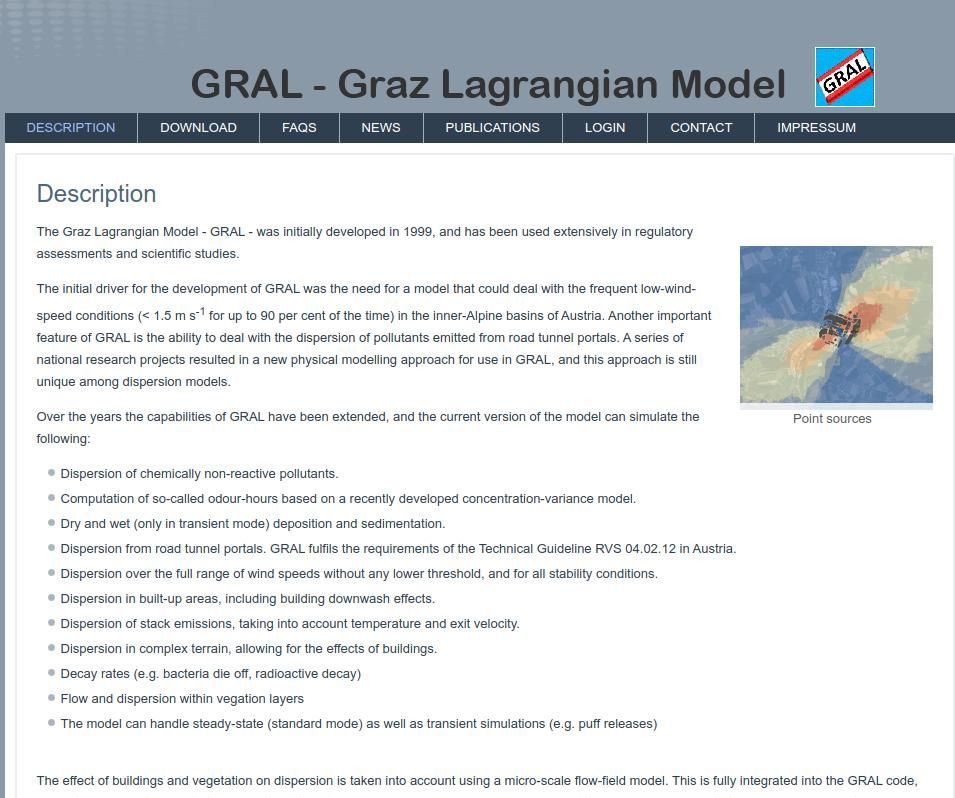
 The Graz Lagrangian (GRAL) system is a Lagrangian particle model with a free Graphic User Interface (GUI) available in both Linux and Windows. Now the developers have released the version 20.09. The software is open source under a GPL-3.0 license, so everybody is welcome to contribute to the project. The source code, has been published in github.
The version 20.09 of GRAL GRAMM has had some changes and modifications in the code, but focusing mainly in correcting bugs. No major features have been included in this update. See a list of issues solved here. The complete source code is published under the GNU/GPL 3 licence.
 The 29th of October took place the second meeting of the group that is dealing with the new Guideline on the assessment of odour exposure by using dispersion modelling. 20 experts from around the world got in this meeting to discuss the next steps in this development. The convenors of this initiative Günther Schauberger and Jennifer Barclay presented some interesting and important points to take into account when modelling with a special focus on the peak to mean approaches.
 The 18th meeting of CEN/TC 264/WG 41 that is dealing with the new standard on Instrumental Odour Monitoring Systems (IOMS) took place last 28th of September. This was a short meeting to discuss some approaches for quality assurance and a call for volunteers to provide data to find out the best way to set a robust confidence interval for IOMSs.