There is no translation available.
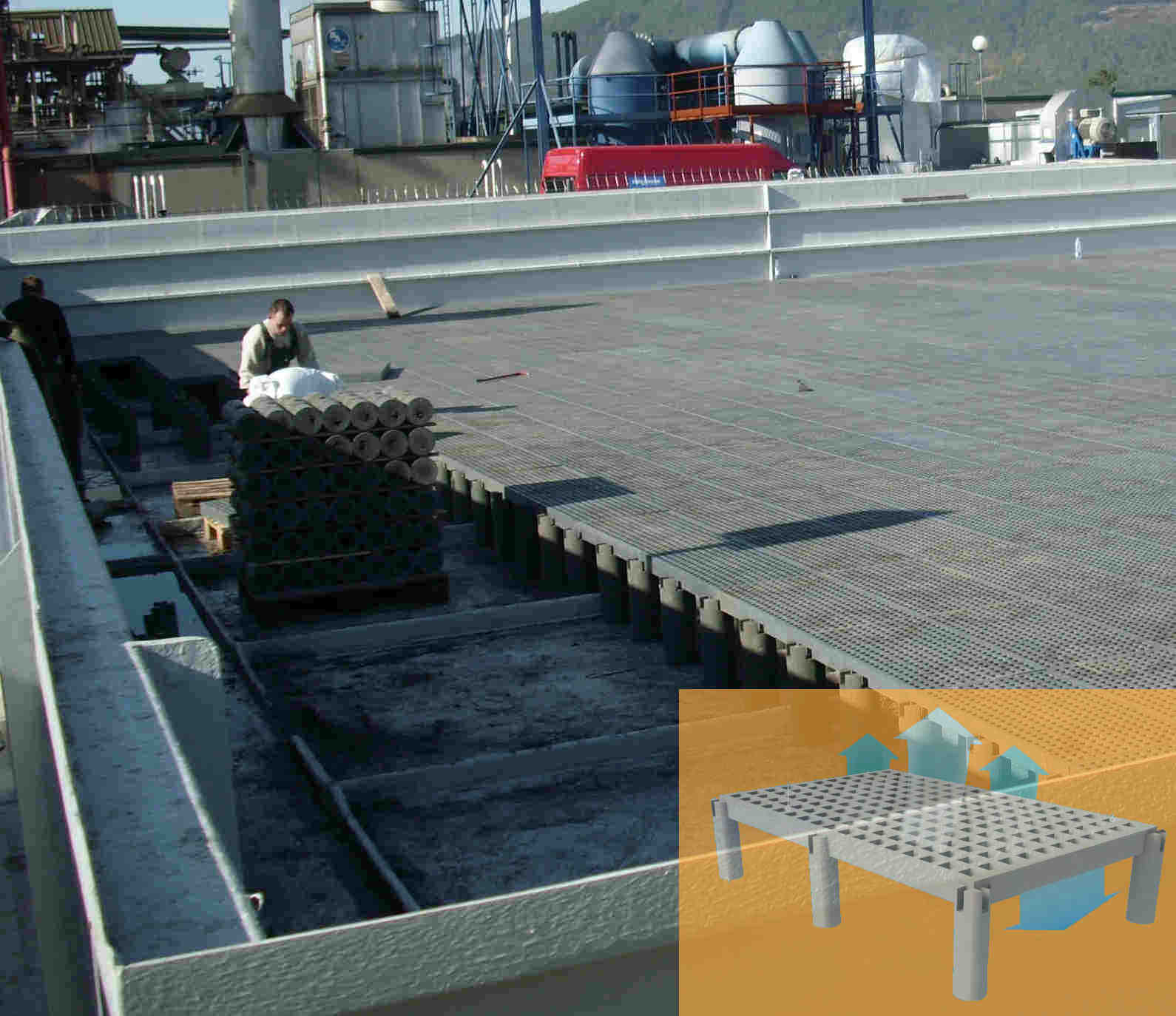 The floor of a biofilter has to meet some stringent requirements. It should provide an excellent drainage with a stream of air with a very high humidity. In addition, the floor has to be loaded with a heavy biofilter medium and it should not be allowed to warp, bend or collapse. The UK company Hahn Plastic Ltd. has developed Hanit®, a new set of plastic grills and legs made of recycled material that is able to stand a biofilter media in extremely harsh conditions.
The traditional option when designing a biofilter floor is using a pre-cast concrete grill. This is often a very convenient way of flooring a a biofilter. The pre-cast concrete structures are resistant, durable under normal conditions and can be easily dismantled, when required.
However transport and handling charges are often a handicap for pre-cast concrete grills. In addition, this flooring has some problems when the air flow has a very high H2S concentration. Concrete gets corroded in these cases and a replacement of the floor has to be made, sometimes after a few years.
 In this sewage plant under consideration, the wastewater is moved vertically using eight Archimedes screw pumps. During the process of moving the wastewater upward, there is an emission of H2S from the surfaces of the Archimedes pumps. Traces of H2S have been detected inside of the building that houses the pump engines.
 Any technological study focused to reduce the odour impact must be based in several steps: from an effective diagnosis, followed by modeling different treatment scenarios, and afterwards doing the Technical – Economic Evaluation (CAPEX / OPEX) of different corrective tecnologies.